
Ihre Ansprechperson: Arjeta · Swiss Vibes travel expert for Gran Canaria
**Roque Nublo.** The striking rock monolith in the centre of the island is its landmark and stands in a high-mountain landscape. The rock rises out of a pine forest and was sacred to the indigenous people. From a car park a well-marked path leads up in a short time. At the top you have an open view as far as the Teide on Tenerife when the air is clear. It is best to start in the morning, as the clouds often come later.
**Artenara.** The highest village on the island has cave dwellings that are still inhabited, and a chapel hewn into the rock, dedicated to the Virgin of the Little Cave. A road winds up in hairpin bends, and at the top there are viewing terraces. In the village there are even homes and restaurants in caves, which stay cool in summer and mild in winter. Winter is fresher here than on the coast, so take a jacket. Spring is ideal.
**Teror.** The town with its basilica is a place of pilgrimage for the island's patron saint, the Virgin of the Pine, who is celebrated on 8 September. The historic houses have wooden balconies, typical of the Canary Islands. On Sunday morning there is a market where you can try the famous Chorizo de Teror. The weather here is slightly cooler and damper than on the coast.
**Puerto de las Nieves near Agaete.** The small harbour on the north-west coast has black rocks, fish restaurants and natural swimming pools in the rock. The striking rock Dedo de Dios, the Finger of God, fell into the sea in a storm in 2005, and its stump can still be seen. In August Agaete celebrates the Fiesta de la Rama with branches and dancing. You come by bus or car, and in spring and autumn the sea is pleasant.
**Barranco de Guayadeque and Agüimes.** The gorge east of Agüimes is known for its cave dwellings, some of which are still in use. A road leads in, and you hike along the valley floor or on small paths. Agüimes itself has a restored old town with colourful houses and small squares, and a coffee there fits the excursion well. In spring the slopes are in bloom.
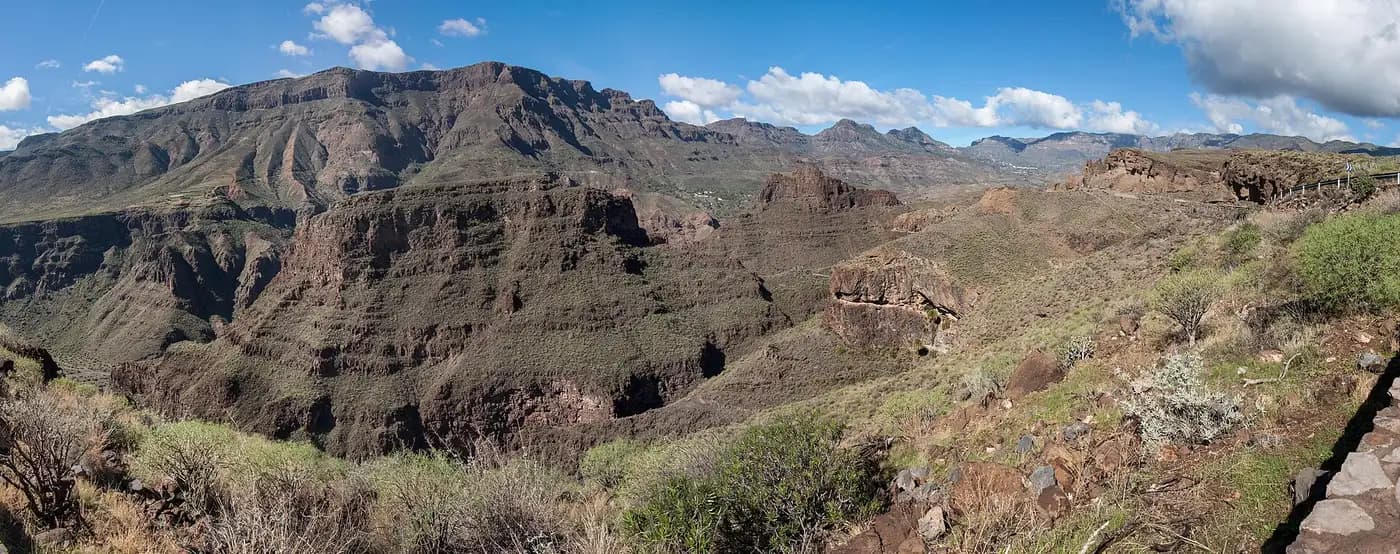
**Tejeda and Roque Bentayga.** The village between the mountains is known for almond pastries and the dessert bienmesabe. In January and February the almond trees blossom, and the valley turns white and pink. Nearby rises Roque Bentayga, a cult site of the indigenous people that you reach on a short path. The road to Tejeda offers views at several points.
**Pico de las Nieves and Ayacata.** The highest point of the island, the Pico de las Nieves, lies not far from Roque Nublo. You can start from Ayacata and walk through pine forest. The Canary pine survives forest fires because it sprouts again after the fire. In spring and autumn the trails are pleasant, and in winter it is cool.
**Fataga valley.** The valley leads from Maspalomas into the mountains and is often called the Valley of the Palms. The village of Fataga lies picturesquely in the greenery, and you drive up a winding road. Here there are almond trees, palms and simple inns serving goat meat and potatoes with spicy sauce. Spring is green and autumn mild.
**Cenobio de Valerón.** Near Santa María de Guía lies a site with chambers dug into the rock, which the indigenous people used as granaries. You climb stairs along the rock face. It is a quiet place away from the beach areas and fits well with a drive to the north. Expect a short visit, as the site is rather small.
**Puerto de Mogán.** In the south-west lies a fishing village with small canals and flowers on the houses. The beach is small and the weather mostly sunny. You can reach the Güi Güi bay further north only on foot or by boat. The village is good for a quiet evening at the harbour, and in winter it is warmer here than in the island's interior.
**Getting there from Switzerland.** Gran Canaria is a popular winter destination. From Zurich, Basel and Geneva you fly to Las Palmas, direct or with a connection depending on the season. You reach the island's interior best by rental car. The mountain roads are winding, so allow more time than the map suggests. The island is mild all year round, ideal for winter travel.
Frequently asked questions
When do the almond trees bloom on Gran Canaria?
Usually in January and February, especially around Tejeda and Valsequillo.
How do I reach Roque Nublo?
By car to the car park, followed by a short, marked footpath.
Is winter a good time to travel to Gran Canaria?
Yes, the coast is mild, but in the island's interior the nights are noticeably cooler.
 Culture & Cuisine
 Party & Nightlife
 City Break
 Golf
 Family
 Bachelor Trips
 Corporate
 Women Only
 Solo